Showing posts with label week 2. Show all posts

Friday, January 16, 2015

Week 2: Parabolas

This Week we looked at Parabolas. Parabolas are U shapes on a graph. 

To find a parabola you use: (x-h)^2=4c(y-k)
vertex: (h, k)
focus: (h, k+c)
directrix=y=k-c
axis of symmetry: x=h

The focus is a point above the vertex of the equation and it is always the C away from the vertex.

The directrix is below the vertex and it is a line that runs parallel to the vertex and is C away from the vertex. 
The above equation is for a vertical equation.

A Horizontal equation would use:

(y-k)^2 =4c(x-h)
vertex= (h,k)
focus: (h+c, k)
directrix: (x=h-c
axis of symmetry: y=k

Below is an example problem on the parabola. 
This is how you solve parabolas and graph them

SEE YOU NEXT WEEK!!!

Thursday, August 28, 2014

Week 2

During Week 2, we finished the chapter on Inequalities, Equations and Graphs. 

On the first day, we first started with a pop quiz and began Algebra and Limits, which included a preview of Calculus.

This was the last section of the first chapter.
We began with the methods on foiling or factoring.
It consisted of:
From then on we reviewed on how to simplify problems down to fractions. The Calculus portion that we followed was limits. 
We learned how there is a number underneath the limit sign and you plug in that number. Most answers are zero. 
To not have an answer of zero, you must factor or cancel, or rationalize the equation till it is simpler and easier. You then plug back in the number listed and you find another number, which is your answer.

You rationalize when the equation has a square root. Then you multiply by its conjugate.
Shown below is an example on how to solve a problem.
That is what we did on the first day.

On the second day, it was review for the test approaching on day 3. We rewiewed on all of the 5 lessons and looked over the homework. The homework was very difficult for many people including myself so we got more help on it and reviewed it. 

On the third day, we had the test on Inequalities, Equations and Graphs. The test was quite difficult and I do hope I had done well on the test taken. 

On the fourth day, we began the next section, which is Functions. We began on Functions and Graphs. 

It is the same material addressed in the previous post. 
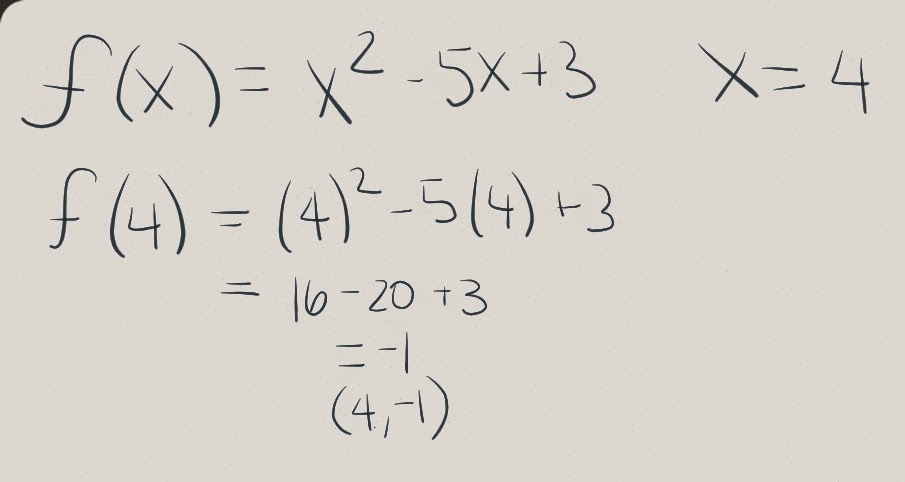
f(x) is the same as y.
You are practically solving for y the whole entire time. 
That is what we learned this week. Next week we will continue on Functions.

See you next week!

Week 2: What is a Function?


A function is usually denoted by a letter such as f, g, or h. It is usually represented as the function f. 
It could be seen usually as
  f(x)=x^2
The f(x) is also the same thing as y
 f(x)=y
The function is similar to something that has an input and to an output. You would plug in a number for x and you will get your result by answering what y would be. Y is the result from the plug in for x. Sometimes it can be switched but it is mostly used as x. 

There are also many types of functions:
x^2 is a function as it is being squared.
x^3+1 is also a function.
Sine, Cosine and Tangent are functions that are used in trigonometry.
There are many types of functions in the world but it is simple and easy to understand.
f is the function name
x is the input
x^2 or y  is the output
f(x)=x^2

One example with f(x)=x^2
x=4
f(4)=x^2
f(4)=16
the output would be sixteen.

x is not the answer but rather a placeholder for the real answer.

Example:

Functions are also used with Domains. Domain is what could be put in? 

Below are a few examples. 


Problems are usually in either square roots or denominators. Using a square root. You would make the square root greater than or equal to zero. 
If using a denominator. You would ignore the top and solve the bottom by making it greater than or equal to zero. The answer will be put in set notation. 

Intercepts are also used. 
Remember, f(x) is the same as y 
So plugging in something to find x you just put it in as zeros or f(x) or y. It's as simple as that.

This is how a function is used in a problem. Functions are not difficult, but rather they are just confusing.

See you next week!