Showing posts with label Semester 2. Show all posts

Thursday, April 30, 2015

Trig Review Week

During this week, we decided to review trigonometry. 
We looked at trying to simplify trigonometry functions and then we looked at verifying. After that we looked at solving trigonometry and looking at the trig identities. All of these identities help us solve, verify and anything dealing with trig.


Trigonometry will be in the final and we reviewed these to understand trig as it was a bit of a struggle for some of us.
This was one of the things we looked at as we reviewed.

SEE YOU NEXT WEEK!!!

Monday, March 9, 2015

Week 10: Sequences and Series

This week we looked at Sequences and Series.
A sequence would look like
a1,a2, a3...an,an+1

To find out how a sequence runs you plug it into the equation that it is given in to n and find a1, a2, etc.

Another type that is looked at is Recursion. Recursion is the use of the term before it so for example a4 would be a3.

So the Arithmetic Sequence which is adding and subtracting has two equations the general and the recursion.
The General equation is: an=a1+(n-1)d
The Recursion equation is a(n+1)=an +d
the d stands for common difference and you can find that by a(n+1)-an
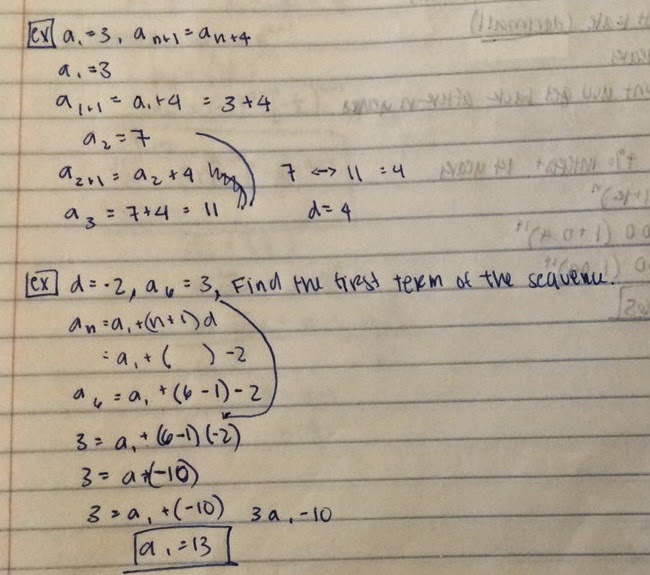
Below are two examples of problems that there are.
The first one is you must figure out the difference by plugging in a1, a2 etc.
The second one you have to find the first term of the sequence by plugging in information given.

Then there is the geometric sequence which is multiplying.
The General equation is an=r^(n-1)
The Recursive equation is a(n+1)=anr
r stands for the common ration and to figure out the common ration you use a(n+1)/an
Below are two more examples on how to plug in and solve for the rate and finding the first term in the sequence.
We then looked at Compound Interest. The equation for compound Interest is An=P(1+r)^n
P stands for Principle or how much you start with
R stands for Interest Rate which needs to be in a decimal
n stands for the number of years
An=the amount you get back after n years

To solve you simply plug in and solve for the necessary number needed.

Then we looked at Series
A Key piece of series is Summation Notation which uses ∑. 
In the above picture of the symbol. It means sum and to solve you plug in the amount for k into the equation how many times the n says.
Below are two examples of how to solve.
Then you get into problems on how to write the summation notation out of a series of numbers.
In the above equation, you first find out whether it is arithmetic or geometric and then find out the rate or distance. After that you plug it into the sequence equation  and then you look for the n. That is how you solve the equation.

There also is the Arithmetic Series
Sn=n(a1+an)/2
n is how many terms and Sn is the sum

There also is the Geometric Series equation.
Sn=a1(a-r^n)/1-r

Lastly here are some properties that are very important in summation notation.

That is what we learned this week.

SEE YOU NEXT WEEK!!! 
*Don’t forget Pi Day*

Friday, March 6, 2015

Week 9: Graphing Systems of Inequalities

This week we covered Graphing Systems of Inequalities in the chapter Systems of Equations and Inequalities. 

This is simply review from Algebra from graphing the inequality and shading. 

First you will:
1. Graph each equations
     a line: y=mx+b
     a parabola: y=(x-h)^2 +k
     a circle: x^2 + y^2 = r^2
2. Pick a test point not on the line
3. Shade the plain containing the test point. If the test point satsifies the equation shade the other plane ift id does not
   ≥ or ≤ solid line
   > or < dotted line

This is how you will solve such a problem.

Below is one example of this problem.

In this problem. You can see the equations being graphed and then finding which side to shade. the place where both lines have shaded is the answer for the equation. 

That is how you graph systems of inequalities

See You Next Week!!!

Friday, February 27, 2015

Week 8: Cramer’s Rule

This week’s blog post is on Cramer’s Rule in the lesson Determinants and Cramer’s Rule. This is in the chapter Systems of Equations. 

In this lesson, we reviewed how Determinants worked from last year. Determinants are practically taking two equation like:
x+2y=3
-3x+5y=7
Then they’re put into an equation with Brackets like
_      _
|   1  2  |
| -3  5 |
You then find the determinant by multiplying cross multiply.
then you subtract.
so it would look like
a  b
c  d  
ad-bc
you multiply a times d and then subtract c times b

For Determinents of 3 by 3
It would be
a b c
d e f
g h i

You then draw it again to
a b c a
d e f d
g h i  g
so you multiply just like you did for hte 2 by 2 but by 3. 

To do cramer’s rule you use the determinant to multiply.
You use the originial numbers from the equations but not taking the answers for the equation or the C for the equation. You then find the determinant of that equation. That will be called D

You then replace the first column with the answers in the original equation and then find the determinant. This will be called Dx

You then replace the second column instead with the answers of the original equation. start all over. the answers in the first column would be the original numbers from the original equation. Find the determinant. This will be called Dy.

Do this however many times you need to if there is a third column it will be called Dz.

To Find x: x=Dx/D
To FInd y: y=Dy/D
To FInd z: z=Dz/D

Then the answer will be (x, y, z)

Below is one example of a problem.

That is how you use cramer’s rule.

SEE YOU NEXT WEEK!!!

Monday, February 9, 2015

Week 6: Graphs for polar equations

Below are two examples of polar equations created to make an image on a polar graph.


See You Next Post

Week 6: Graphs of Polar Equations

This week we looked at the Graphs of Polar Equations. 

The Polar Equations had many different Graphs

There were circles, lines, spirals, more circles, rose curves and even more.

We more or less looked at the equation for them.

For circles at the origin
r=a where a is the radius

For Lines through the origins
θ=a

For Spirals:
r=aθ

For Circles with the center on the axis
r=asinθ This is on the y-axis
r=acosθ this is on the x-axis a=diameter

Then for Rose curves
r=asinnθ
r=acosnθ
a means the length of the petal
an odd n=n=number of petals
an even n=2n= number of petals
a^2 =how long
n=how many

for a Lemniscate:
r^2 =acos2θ
r^2 =asin2θ
the sin graph is on the x=y axis

For Cardiods
r=a±asinθ
r=a±acosθ

For Limacons:
r=a±bsinθ
r=a±bcosθ
a/b < 1 interior loop
1<a/b<2 dimpled
a/b≥ 2 convex


This is what we did and how you use these polar equations

SEE YOU NEXT WEEK!!!

Friday, February 6, 2015

Week 5: Polar Coordinates

We looked the Polar Coordinate System, which we have never really used before. We have always used the rectangular coordinate system but not the polar.

The Polar Coordinate System uses (r, θ)
r is the direction it goes in a circle and if the θ>0 then it is counterclockwise if it is less then 0 then clockwise

TO convert polar to rectangular
you use x=rcosθ and y=rsinθ

To convert rectangular to polar you use r^2 =x^2 + y^2 and tanθ=y/x
above is an example of a polar equation being put on the graph. There also are four ways of naming in polar coordinates. Above are the four examples.

These equations are also used to solve for the other side in rectangular and in polar.

Here is an example.
It is similar to verifying but not at the same time.

This is the polar coordinate system

SEE YOU NEXT WEEK!!!


Friday, January 23, 2015

Week 3: Rotation of Conics

We looked at the rotation of conics. In an equation it would have Ax^2 +Bxy +cy^2+ Dx + Ey + F=0
There cannot be a Bxy in an equaiton at all.
To get rid of it you first
Step 1: Find the angle with cot2θ=A-C /B 0<θ<90
Step 2: You replace x&y x=x^1 cosθ-y^1 sinθ and y=x^1 sinθ+y^1cosθ
Step 3: Then you use Algebra to simplify

It sounds easy at first but it is so much more.
Here’s some helpful hints:
1+cot^2 θ=csc^2 θ
cos2θ
sin2θ
and
sinθ=√1-cos2θ/2
cosθ=√1+cos2θ/2
Here is one problem below
It is a lot more complicated. Just like the steps you plug in to find the angle and then replace the x and y to find the answer and then simplify. 
Below is another example:
This time, instead of looking for the angle, you put it into the sinθ/cosθ equation and solve. 

Then there will be times when you solve but you just want to find out what shape the equation is. Then you use 
B^2 - 4AC = 0 Parabola
B^2 - 4AC < 0 Ellipse
B^2 - 4AC > 0 Hyperbola
Below is an example and then two problems


This is how you solve rotation of conics

SEE YOU NEXT WEEK!!!

Friday, January 16, 2015

Week 2: Parabolas

This Week we looked at Parabolas. Parabolas are U shapes on a graph. 

To find a parabola you use: (x-h)^2=4c(y-k)
vertex: (h, k)
focus: (h, k+c)
directrix=y=k-c
axis of symmetry: x=h

The focus is a point above the vertex of the equation and it is always the C away from the vertex.

The directrix is below the vertex and it is a line that runs parallel to the vertex and is C away from the vertex. 
The above equation is for a vertical equation.

A Horizontal equation would use:

(y-k)^2 =4c(x-h)
vertex= (h,k)
focus: (h+c, k)
directrix: (x=h-c
axis of symmetry: y=k

Below is an example problem on the parabola. 
This is how you solve parabolas and graph them

SEE YOU NEXT WEEK!!!